
How GIS Supports Environmental Impact Assessments (EIA): Constraints Mapping, Habitat Analysis and Planning Support

Environmental Impact Assessments (EIA) play a crucial role in ensuring that development projects proceed with minimal harm to the environment. Geographic Information Systems (GIS) have become indispensable tools in this process, offering powerful ways to collect, analyse, and visualise spatial data. This blog explores how GIS supports EIAs across various stages, from site selection to environmental decision-making, with practical examples and insights for environmental consultants, planners, renewable energy developers, councils, and GIS professionals.

How GIS Enhances Site Selection and Constraints Mapping
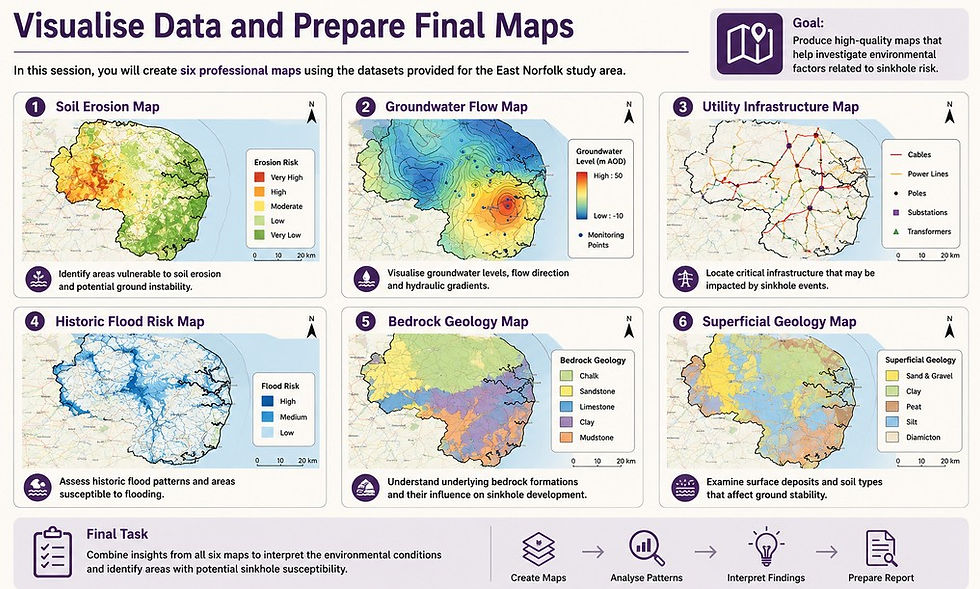
Choosing the right site for development is one of the earliest and most critical steps in an EIA. GIS allows users to overlay multiple environmental datasets to identify suitable locations while avoiding sensitive areas. Common datasets include:
Sites of Special Scientific Interest (SSSI)
Special Areas of Conservation (SAC)
Special Protection Areas (SPA)
Ramsar wetlands
Flood zones
Habitat distribution data
Geological information
By combining these layers, GIS helps create detailed constraints maps that highlight areas where development may face legal or environmental challenges. This spatial analysis reduces the risk of costly delays or redesigns later in the project.
For example, a renewable energy developer planning a wind farm can use GIS to exclude sites overlapping with SPA or Ramsar sites, ensuring compliance with conservation regulations. Similarly, flood risk zones can be mapped to avoid vulnerable locations.
Habitat Analysis and Biodiversity Assessment
Understanding the habitats present on or near a project site is essential for assessing potential impacts on biodiversity. GIS supports habitat analysis by integrating field survey data with existing habitat maps and satellite imagery.
Environmental consultants can use GIS to:
Map habitat types and their extent
Identify protected species’ habitats
Analyse habitat connectivity and fragmentation
Assess potential impacts on wildlife corridors
This spatial insight guides mitigation strategies such as habitat restoration or the creation of buffer zones. For example, GIS can reveal if a proposed infrastructure project would fragment a woodland area critical for local species, prompting design adjustments.
Flood Risk Assessment Using GIS
Flood risk is a major concern in many development projects. GIS tools enable detailed flood risk assessments by combining elevation models, hydrological data, and historical flood records.
Key GIS applications in flood risk assessment include:
Mapping flood zones based on Environment Agency data
Modelling surface water flow and drainage patterns
Identifying areas prone to flooding during extreme weather events
Supporting the design of flood mitigation measures
By visualising flood risks spatially, planners and developers can avoid high-risk areas or design infrastructure to withstand flooding. This reduces potential damage and supports resilient development.
GIS in Renewable Energy Projects and Visibility Analysis
Renewable energy projects, such as wind farms and solar parks, require careful environmental assessment to balance energy generation with ecological and social factors. GIS plays a vital role in:
Site suitability analysis considering environmental constraints
Visibility analysis using Zone of Theoretical Visibility (ZTV) models
Assessing proximity to protected sites and habitats
Planning access routes and infrastructure with minimal environmental impact
ZTV maps generated in GIS show where turbines or solar panels will be visible from surrounding areas, helping to address visual impact concerns during public consultations and planning applications.
For example, a wind farm developer can use QGIS to create ZTV maps that identify areas where turbines will be visible from residential zones or protected landscapes, informing turbine placement and design.
Infrastructure Planning and Environmental Decision-Making
GIS supports infrastructure planning by providing a spatial framework to evaluate environmental, social, and economic factors simultaneously. It helps decision-makers:
Compare alternative routes or sites
Assess cumulative environmental impacts
Identify areas requiring environmental mitigation
Communicate findings through clear, professional maps
Environmental consultants rely on GIS tools like QGIS to analyse spatial data efficiently, identify risks, and produce maps that support planning applications and stakeholder engagement.
For instance, when planning a new road, GIS can highlight sensitive habitats, flood zones, and archaeological sites along different route options, enabling informed decisions that minimise environmental harm.
Benefits of GIS for Environmental Consultancies, Local Authorities, and Developers
GIS offers several advantages for all stakeholders involved in EIAs and sustainable planning:
Improved accuracy in identifying environmental constraints and risks
Faster analysis of complex spatial data sets
Clear visual communication through maps and reports
Better compliance with environmental regulations
Enhanced collaboration between consultants, planners, and developers
Cost savings by avoiding unsuitable sites and reducing redesigns
Local authorities benefit from GIS by efficiently reviewing planning applications and ensuring developments meet environmental standards. Developers gain confidence that projects are viable and environmentally responsible.

Using QGIS for Environmental Impact Assessments
QGIS is a popular open-source GIS tool widely used by environmental professionals. It offers:
Support for numerous environmental data formats
Tools for spatial analysis, buffering, overlay, and modelling
Plugins for habitat mapping, flood risk, and visibility analysis
Capabilities to produce high-quality maps for reports and presentations
Environmental consultants can use QGIS to integrate datasets such as SSSI boundaries, flood zones, and habitat data, perform spatial queries, and generate maps that clearly show environmental constraints and opportunities.
Final Thoughts on GIS and Environmental Impact Assessments
GIS has transformed how environmental impact assessments are conducted, making the process more precise, transparent, and efficient. By integrating diverse environmental datasets and providing powerful analysis tools, GIS supports better site selection, risk identification, and decision-making.
For environmental consultants, planners, renewable energy developers, and local authorities, mastering GIS tools like QGIS is essential to deliver high-quality EIAs and sustainable projects.
If you want to enhance your GIS skills and apply them effectively in environmental assessments, consider VanguardGeo’s GIS training and workshops. Their expert-led courses provide practical knowledge tailored to environmental professionals, helping you unlock the full potential of GIS in your projects.


Comments